

“We filled out the FAFSA, but the college says we need to pay more than what we actually can.”
That’s because what the federal government means by ‘need’ isn’t necessarily what you or the college mean.
Financial aid is one of the least transparent aspects of higher education. Sticker prices can be highly inflated, forms complex, and the timing of the process hectic. Many families assume “need-based” means the college will cover what they can’t. The reality is, colleges have limited aid funding, and most won’t be able to meet all need. That said, with the right approach, you will receive a financial aid award that’s right for you.
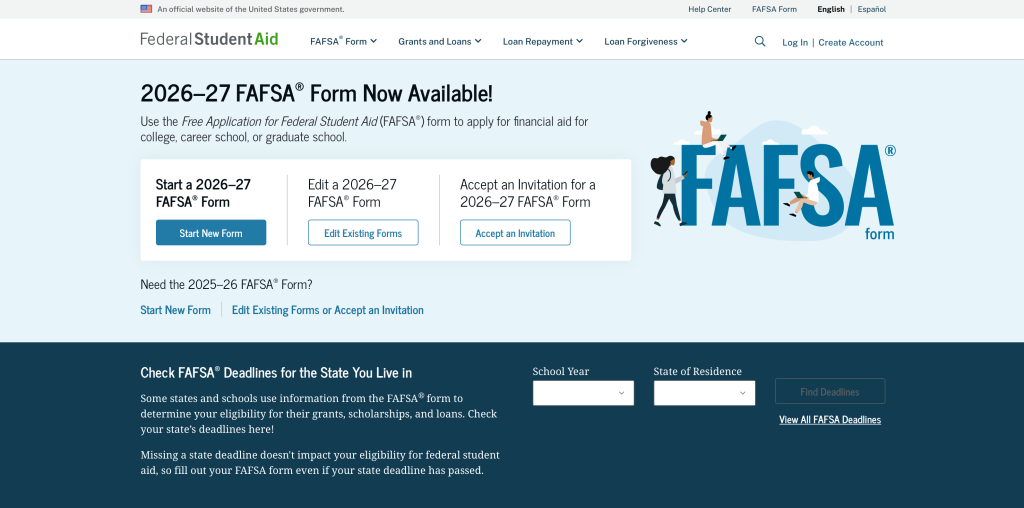
FAFSA: the federal form
The Free Application for Federal Student Aid (FAFSA) produces a Student Aid Index (SAI), formerly called Expected Family Contribution (EFC). It’s a starting point for what the federal government calculates as your need. It is not a promise of aid.
- FAFSA determines eligibility for federal grants, loans, and work study
- Completing the form requires SSNs, tax forms, and other documentation.
- The form asks for “prior-prior” year financial data: for the 2026-27 academic year, the form requires 2024 tax data.
- Two families with the same income can have different SAIs.
- Many states use FAFSA results to determine eligibility for their own benefits.
- FAFSA is required each year your student is enrolled in college.
Many institutions use the FAFSA form as their sole source for determining your federal, state, and institutional aid eligibility. Others ask for the additional CSS Profile (see below). The SAI provides a uniform formula across the millions of students who apply for financial aid annually.
CSS Profile: the private formula
Whereas the FAFSA is a snapshot, the CSS is a close-up.
About 200 selective colleges use the College Board’s CSS Profile. Unlike the FAFSA, the Profile includes home equity, retirement contributions, private school tuition, and more. It, too, uses a formula to calculate financial need. You may find that the CSS calculation differs from FAFSA. This is not unusual. Colleges take both into consideration when developing your financial aid. Based on an individual student’s FAFSA and CSS results, schools determine their own mix of scholarship, loan, and work study that they will award.
“Need-blind” doesn’t mean unlimited aid
“Need-blind” means admissions officers don’t see your finances while making admission decisions. It does not imply how the school will interpret your financial aid forms, nor does it mean the school will meet every dollar of your need. A handful of schools (Harvard, Princeton, Amherst) do meet full need for all admits, some with a no-loan feature. (Bravo!) Most do not. For the majority of institutions, meeting need does include a loan component.
Comparing offers is important
Once college decisions come back, it’s important to compare the composition of different financial aid awards, not just the bottom-line dollar amount. Two colleges may provide the same quantity of aid, but differ wildly in how much scholarship is awarded or how much loan and work-study is expected. For example, one school might cap student loans, whereas another may package a higher proportion of student, parent-plus, and private loans. Some offer merit aid beyond need; others count the merit aid as part of your need. Some count outside scholarships against your aid while others don’t.
The review process
If aid you’ve been offered doesn’t match your expectations, you should ask for a review. Colleges often reconsider when you:
- Document job loss or income change.
- Show new financial responsibilities (medical, elder care, etc.).
- At some schools, present better competing offers from peer institutions, triggering a process of review.
Some schools welcome the exchange; others, which tend to be the most selective, can be less flexible.
Financial aid reviews aren’t begging. They’re a normal, respectful part of the process.
Only you can determine the value of an aid award
The details matter. Comparing awards with the eye of an expert can help decipher your true four-year cost. While FAFSA and the CSS Profile can give you an idea of how much college will cost, schools are free to use their own scholarship funds and methodologies as they see fit. For example, analyzing the percentage of grant awards relative to tuition and fees can help you assess the real value of a package.
In our experience, the most selective schools offer generous financial aid awards. But they can be less flexible once an award is delivered. Some of the biggest financial benefits come from schools one or two tiers below the most selective. These colleges are often more willing to talk as they compete to recruit students with strong merit aid.
Bottom line
Complete both the FAFSA and the CSS Profile. Apply to a range of reach-, target-, and likely-to-admit schools and compare offers. Meet all deadlines and closely review the grant, loan, and work components of any financial aid award. Differences in aid packages across colleges and higher education options can be dramatic.
Schedule a call today
Ecstawrite helps families strategize for both fit and financial reality. We make the aid process more rational and understandable, demystifying industry mist so that you receive the financial aid your student merits.
Leave a Reply