
I recently teamed up with my nephew to form an independent college counseling concern. He’s a former journalist, English tutor, and fiction writer. I spent forty plus years in college admissions. He’s convinced of the application as narrative. I’m the conservative influence focused on academic credentials. So I’ve been thinking a lot lately about scholastic merit, and how the definition has changed.
In the 1970’s when I went to college, merit meant exclusively “the best numbers”: SATs and grades. There could be only one student at the top of the class, usually the one with the highest test scores, and we thought of her as the most meritorious. For her, college scholarships followed.
But there have been some tectonic developments since then — in my opinion some for the good, some for the bad, some outright cynical.
A lesson in the slipperiness of “merit”
I received my first lesson in the slipperiness of the term “merit” when I was Admissions Director at a small liberal arts college in the Northeast in the early ’90’s. The college was in trouble, the president recently run outta town, and I was hired to bring in freshmen bodies. The problem was that my only admissions experience was with a very selective college where the main task of the Admissions Office was to find reasons to deny students (and to hone the skill of talking but not really explaining to disappointed parents why their kid didn’t get in).
Nevertheless, I was tossed into the fire and for a time failed miserably. Until I attended a conference, headlined by a former member of the President’s Council of Economic Advisers, where I learned, before most of my competitors, about econometrics and its application to college pricing. These were the days well before the private-equity-funded, price-discriminating consultants of today.
How “merit” became a pricing tool
For a small stipend I hired a campus economist. We crunched the numbers and figured out how much to give to whom, a cohort which comprised almost everybody who applied regardless of our prior need-based aid practices. I remember when I asked the professor, “What do we call this money in our award letters if it’s not a need-based grant?”
“Merit scholarship,” he answered in a heartbeat.
“Don’t they need to believe they earned the money?”
“So make them interview,” he said.
We did, requiring our scholars to sing for their suppers, and filled the class and the college coffers. Our success continued until others caught on to the technology. With a stroke of the pen, or a whirr of the computer, merit was redefined.
The definition of merit must shift again
Today, it is in the interest of the hundreds of mid- to lower-tier colleges, many with fine reputations yet hungry for bodies, to continue to play fast and loose with how they measure achievement.
Higher education has a history of normalizing the definition of merit on the population of white males. But over the last twenty-five years the composition of the pool of college-going students has changed. Nationally, the percentage of non-whites at degree-granting institutions has jumped from 30% to 45%. Males represent just 42% of college students. Pell Grant recipients have grown from 4.5 million to 6 million. If the current administration in Washington has its way, we may lose track of these numbers altogether. But not counting won’t alter the trend: a decreasing college-going population less male, less white, less able to pay, and more ethnically diverse.
In the face of such a dramatic remaking of the student body — along with Covid’s aftershocks, the collapse of standardized testing, and the rise of inflated and unreliable high school GPAs — the pricing game of the last two decades is yielding diminishing returns.
How are we now to assign merit?

Contribution, resilience, and grit
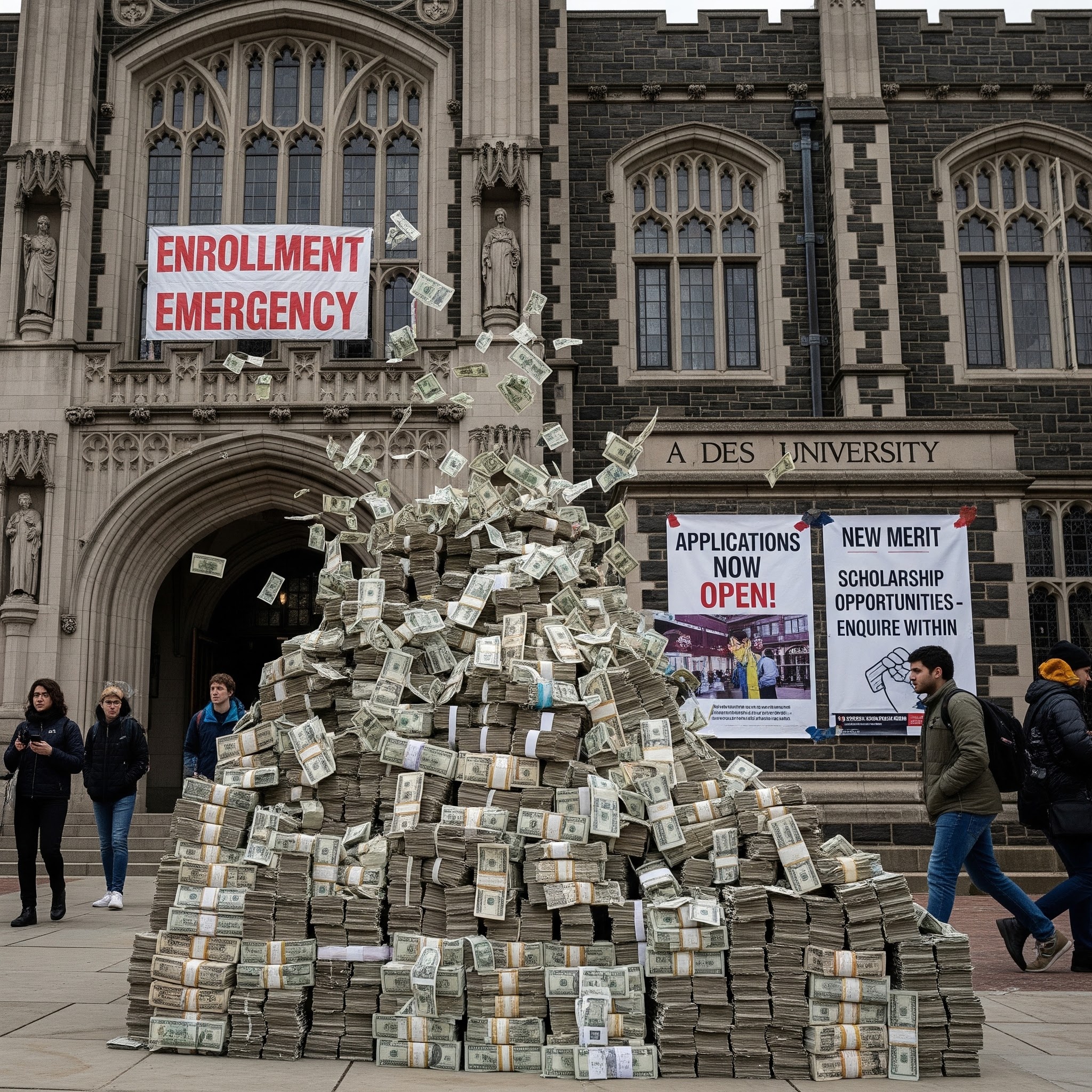
It turns out the answer for many institutions is to double down on holistic assessment of applicants, shifting away from “objective,” quantitative metrics of academic performance and toward a broader assessment of a student’s potential contribution — not just what a student may have achieved on her own in the classroom by traditional standards, but also what her presence adds to a community.
Of course, reading for the whole person has been the way of selective colleges and universities all along: They’ve always chosen who they’ve darn-well wanted to walk through their hallowed halls. But now even those colleges not as selective are moving holistic evaluation to the heart of the admissions process. Merit, in this new sense, lives in how students learn and what circumstances they’ve overcome, putting into context what they’ve achieved.
And lo and behold, the bulk of colleges have once again redefined merit, creating new ways to distribute aid and maintain enrollments — just in time for the looming demographic crash! “Show us your obstacles,” their Admissions Deans say, “and you will thereby be meritorious and worthy of scholarship.”
Context has become the new merit. Admissions officers now read applications less burdened by traditional criteria, if they require such criteria at all. Even many top schools report SAT/ACT submissions at only 25-50% of their incoming populations. Applicants are read in place. What opportunities were available to this student? What barriers did they face? How far did they travel from where they started?
What this means for students
For some families (and faculty), this shifting view of merit can feel destabilizing and unfair. The old formulas — test prep, perfect grades, leadership titles — might still win the day, but aren’t the only avenue to reward. While numbers still matter at the most selective institutions, strong applicants at most schools now emerge from a student’s sense of self, the college application a performance of reflection, curiosity and character. And let’s not forget emotional resilience.
An applicant’s well-told story about giving back, community, and belonging can quietly signal what demographics and numbers can’t. (Especially after the Supreme Court’s decision restricting race-conscious admissions, contextual evaluation has been tricky, but that’s a question for another day.) It seems the heart of the New Merit is for an applicant to be seen fully and to allow readers in.
Merit hasn’t disappeared; it’s evolved. In an increasingly diverse, post-Covid, test-optional, resource-starved, demographically-challenged world, excellence looks less like a perfect high school transcript and more like a coherent life.
For my young partner and me, this change, even if at times motivated by tuition dollars, is for the better. After all, I’m a former English TA and he’s still laboring in the field. We want to believe stories are important. We want to be able to tell our charges that their stories matter.
Schedule a call today
At Ecstawrite, we help students compose their stories in a compelling way. Schedule a free consultation to begin the work of crafting a narrative to which admissions offices respond.
Leave a Reply